Stop Guessing The Request Lifecycle
A pint-sized book you can sip over the weekend to finally understand the Express processing pipeline that turns requests into responses.
Master the Core Express Features First
All you need to start building APIs is to learn the core Express features that do 80% of the heavy lifting on a daily basis.
Most Express courses try to teach too much too soon.
They move from the framework into architecture, databases, project structure, and production concerns before you have enough time to understand Express itself.
But to start building useful APIs, you do not need the whole backend ecosystem at once. You need a practical understanding of the request-response flow: how your app routes requests, reads data, validates input, sends responses, and handles errors.
That is exactly what The Express.js Weekend focuses on: the core Express flow, taught through one complete API you can finish over the weekend.
A Practical Express API Brewing Guide
This book is designed to help you understand Express by building your first complete API from start to finish in a single weekend.
The book is built around one small Pastebin-style API.
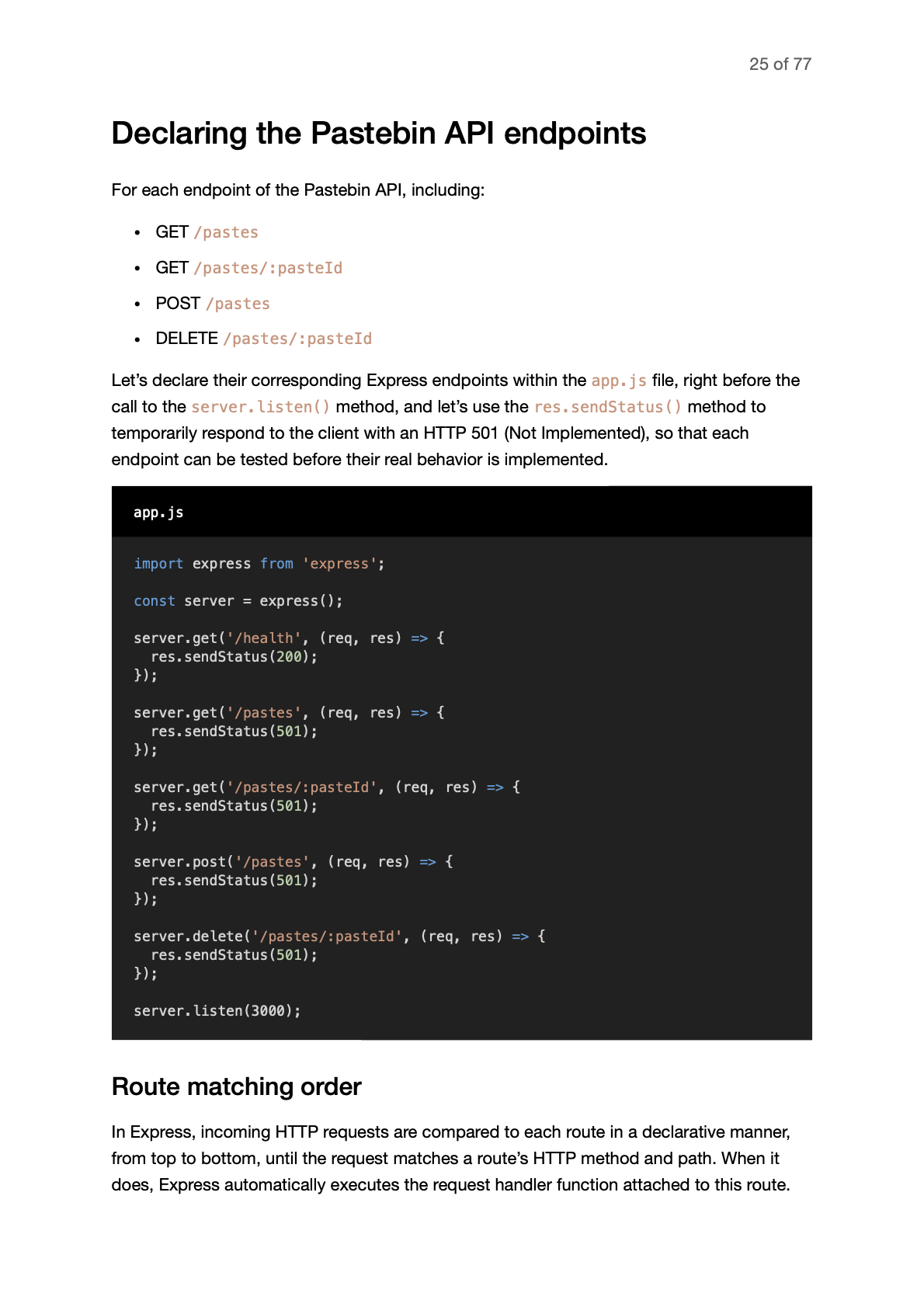
You will implement a health check endpoint, a fallback endpoint, and the core endpoints required to create, retrieve, list, and delete text snippets called pastes.
Chapter by chapter, you will add the pieces that make an Express API work: routing, request handlers, body parsing, request data, responses, validation, routers, and error handling.
The goal is not to make you memorize Express examples.
The goal is to help you understand how the request moves through the application, which part of the code handles each step, and how those pieces work together inside one complete API.
By the end, you will have a working API, a clearer mental model of Express, and a practical reference point for your next backend project.
View the chapters
1. What You Are Building
You'll walk through the Pastebin-style API you will build and the core Express concepts it will help you understand.
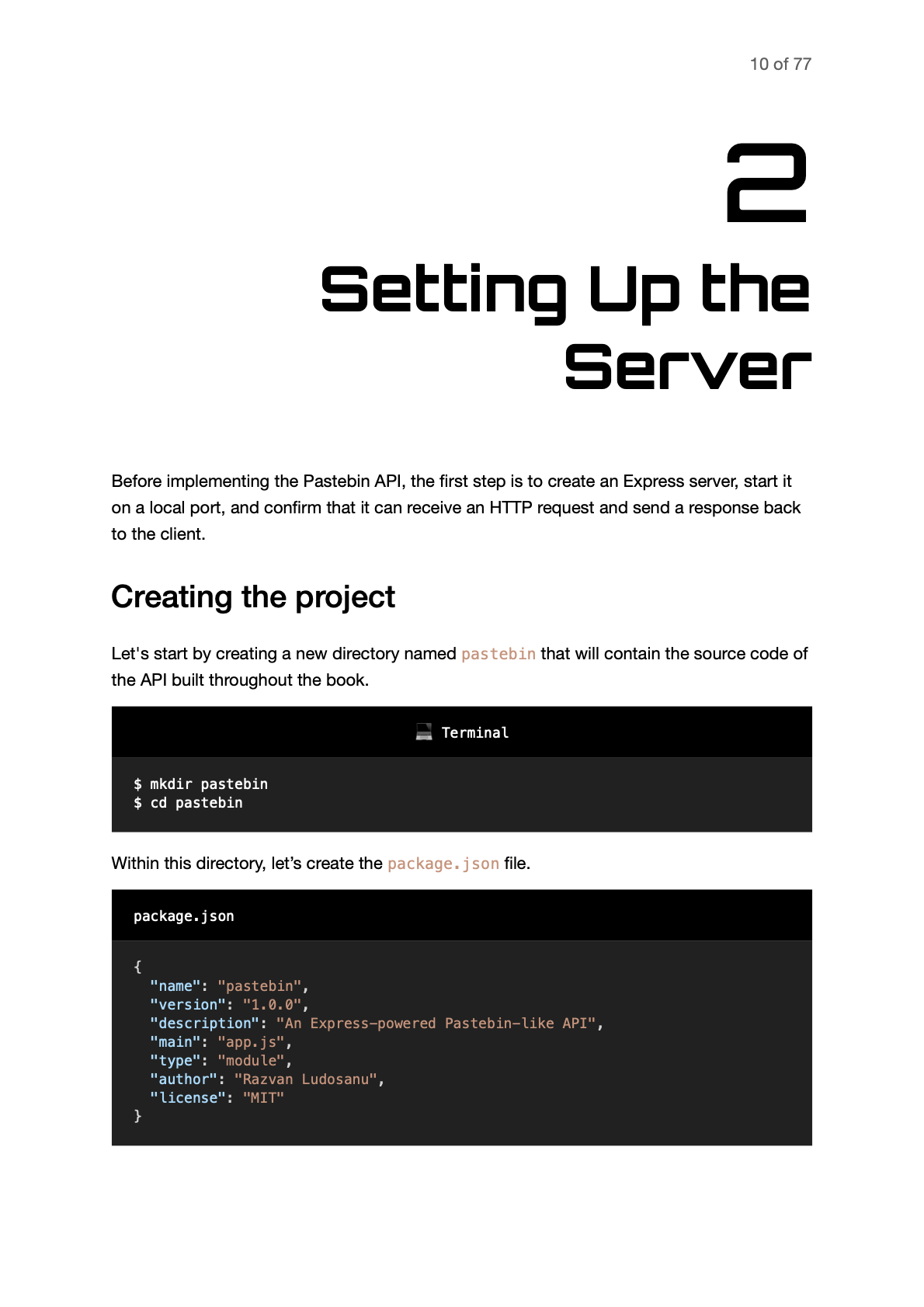
2. Setting Up the Server
You'll create the Express application, start the HTTP server, and make sure the API can receive requests.
3. Routing HTTP Requests
You'll define the first HTTP routes and connect incoming requests to the right request handlers.
4. Sending HTTP Responses
You'll return JSON responses with the right status codes so the API can communicate clearly with clients.
5. Setting Up an In-Memory Database
You'll create a simple in-memory database to store and retrieve pastes while keeping the project focused on Express.
6. Refactoring Request Handlers
You'll clean up the request handlers so the endpoint logic stays easier to read, extend, and maintain.
7. Retrieving Public Pastes
You'll implement the endpoint that returns the list of public pastes available through the API.
8. Retrieving a Single Paste
You'll implement the endpoint that retrieves one paste by reading its identifier from the request URL.
9. Creating a New Paste
You'll implement the endpoint that reads JSON data from the request body and creates a new paste.
10. Deleting Pastes
You'll implement the endpoint that deletes an existing paste by using the identifier provided in the request URL.
11. Grouping Routes with Routers
You'll move related routes into an Express router so the API structure stays easier to navigate as it grows.
12. Validating Request Data
You'll validate incoming request data before it reaches the endpoint logic, so the API can reject invalid input early.
13. Handling Runtime Errors
You'll add a predictable error-handling flow so runtime failures are turned into clear HTTP responses.
14. Final Review
You'll review the complete request-response lifecycle and connect everything you built into one clear Express mental model.
WHO THIS IS FOR
This is PERFECT for you if:
You know JavaScript, you have touched Node.js before, and you want to understand how Express works by building one small but complete API.
You can probably make an Express route respond already.
What you want now is to understand the flow clearly enough to stop stitching endpoints together from scattered examples.
This is NOT for you if:
You are looking for a complete backend architecture book, a database design course, an authentication system, or a production deployment guide.
The Express.js Weekend focuses on the core Express request-response flow.
What You'll Know by Monday
By Monday, you will understand the main ingredients that make an Express API work from request to response.
HTTP routing
Define routes that map incoming HTTP requests to the right part of your Express application.
Request data
Read route parameters, query strings, and JSON bodies without mixing them up.
Response handling
Return clear HTTP responses with proper status codes and JSON payloads.
Request handling
Write handlers that receive requests, run endpoint logic, and control what happens next.
Data validation
Check incoming data before your API accepts it or runs the endpoint logic.
Error handling
Handle runtime failures through one predictable error flow across your API.

Hi, I'm Razvan 👋
I'm a senior Node.js developer with 15 years of professional experience building backend systems for all kinds of startups.
I love coding, but I hate learning passively by reading or watching for hours before building anything useful.
Express is often taught through small disconnected examples. One route here, one middleware there, one error handler somewhere else.
That can help you get started, but it does not always help you understand the full request flow.
I wrote The Express.js Weekend to give you the practical shortcut I wish I had when I started building APIs with Express: one small project, one clear flow, and enough implementation detail to make the pieces finally connect.
Stop Patching Express Routes Until They Work
Build your first complete Express API over one focused weekend and finally understand how the request flows through the server.
15 practical chapters
90 focused pages
PDF version
Complete API source code
FAQ
What will I be able to do after reading The Express.js Weekend?
You will be able to build a small but complete Express API and understand how a request moves from the route, to the handler, to the final response.
Will this help if I already know some Express?
Yes. The book is useful if you have used Express before but still feel like routes, request data, responses, validation, and errors are disconnected pieces. The goal is to connect them into one clear flow.
Will this help me build production APIs?
It will help you understand the core mechanics behind Express APIs. It is not meant to cover every production concern, but it gives you the foundation you need before moving into architecture, authentication, databases, testing, and deployment.
Will I write code or only read explanations?
You will write code. The book is built around a small Pastebin-style API, so each concept is introduced in the context of something you are building.
Is this for complete beginners?
It is not for someone learning JavaScript for the first time. You should already know basic JavaScript and understand what Node.js is. You do not need to be comfortable with Express yet.
Why not just follow free tutorials?
Free tutorials can show you isolated examples. The Express.js Weekend is meant to give you a guided path through one complete request-response flow, so the pieces start making sense together.
What should I know by Monday?
You should know how to declare routes, write request handlers, read request data, send responses, handle common errors, and understand how those pieces work together inside one Express API.
Is this the same as The Express Brew Kit?
No. The Express.js Weekend helps you learn Express by building a small API. The Express Brew Kit helps you start real Express APIs from a reusable implementation standard. The Weekend is the learning path. The Brew Kit is the building shortcut.
I have more questions
Send me an email at support@backendbrewery.dev, I'll get back to you within 1-2 business days.
Get a FREE Chapter
Want a small taster before the offical release?
Enter your email below and you'll be the first to know when the brew guide is released, plus we'll pour a free chapter about routing HTTP requests straight into your inbox.